
Why Routing and Pathways Should Never Be Treated as Minor Details
In most projects, routing and pathways are treated as secondary concerns. Yet they are often the root cause of performance failures, rework costs, and long-term infrastructure limitations.
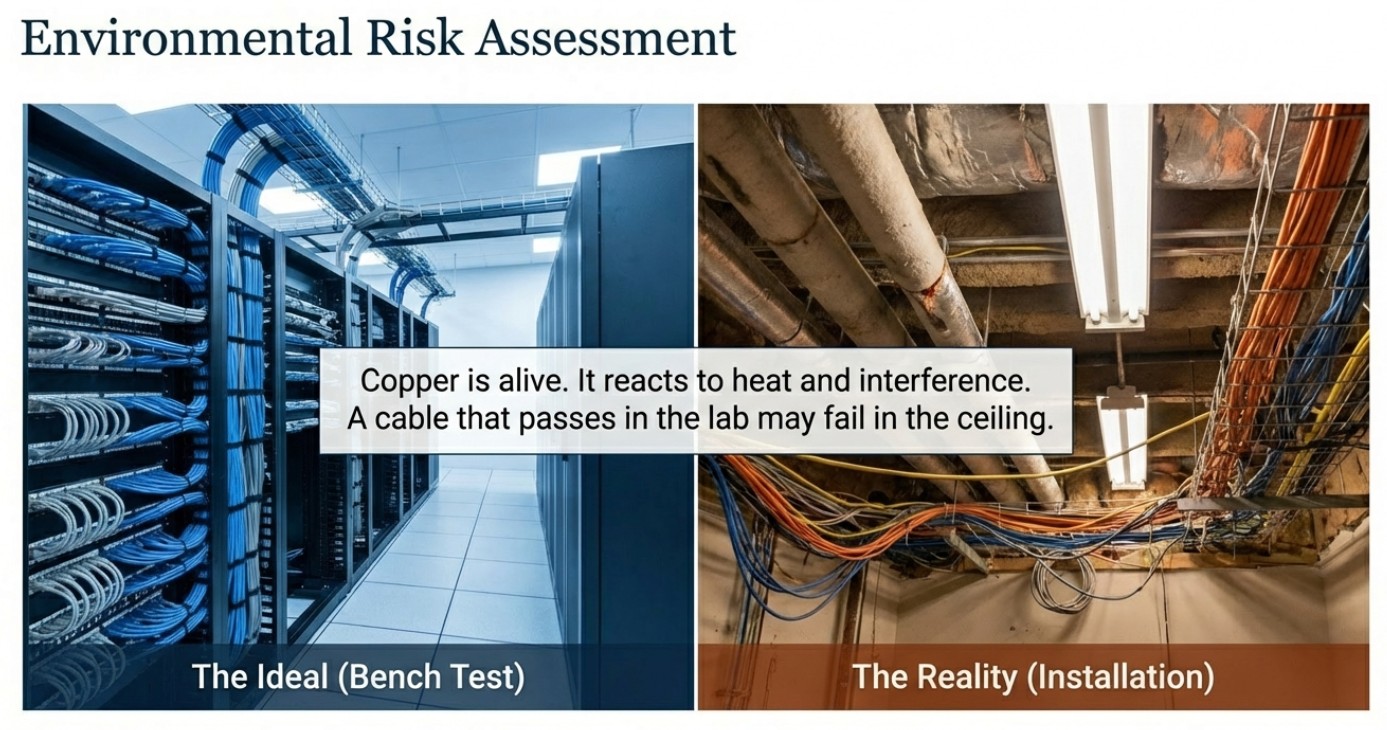
In most ICT infrastructure projects, routing and pathways are treated as secondary concerns — something to be sorted out during installation, not during design. This is a costly mistake.
Why Pathways Matter
Pathways determine where cables run, how they are protected, how they perform over time, and how easily they can be maintained or upgraded. Poor pathway planning leads to cable damage, performance degradation, fire safety compliance failures, and expensive rework.
Copper cabling is particularly sensitive to its environment. Heat, electromagnetic interference, and physical stress all affect performance. A cable that passes a bench test may fail in a ceiling if it runs too close to fluorescent lighting, HVAC ducting, or power cables.
Common Pathway Planning Mistakes
- Routing decisions made too late in the design process
- Insufficient cable tray capacity for future growth
- Failure to separate data and power cabling
- Inadequate fire stopping at penetrations
- Routing through high-temperature zones without appropriate cable specification
The Design-Stage Opportunity
The best time to address pathway planning is during the design stage — before construction begins. At this point, changes are inexpensive and straightforward. After construction, they become costly and disruptive.
DTNC works with consulting engineers, developers, and project teams to ensure pathway planning receives the specialist attention it deserves — early in the process, when it matters most.
About the Author
DTNC — Specialist ICT Infrastructure Consulting & Training
DTNC provides specialist consulting, project advisory, and practical training for ICT infrastructure professionals. Our insights are drawn from real-world experience across structured cabling, fibre networks, WiFi, CCTV, access control, and smart building environments.



Ready to discuss your project?
DTNC provides specialist consulting, project advisory, and practical training for ICT infrastructure professionals.